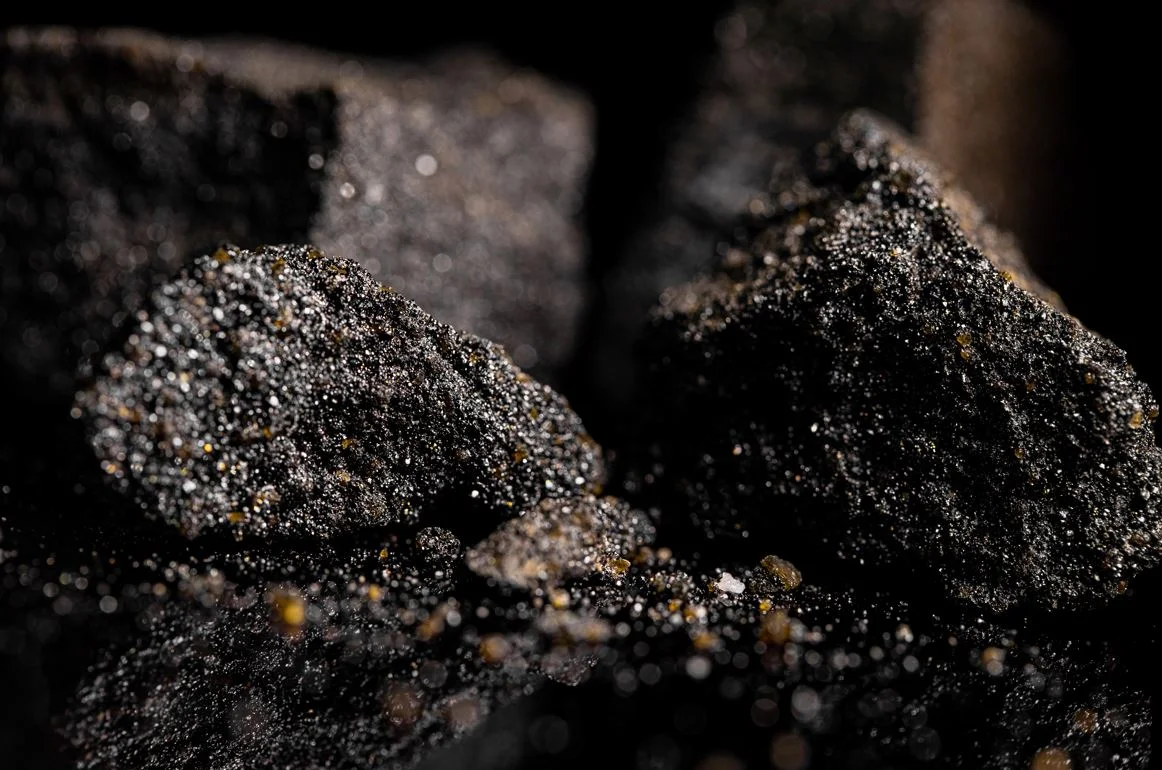
Moss Agate Coal Product Specifications (Smelting Grade)
Our smelting-grade coal is rigorously tested consistently delivers the following properties, making it a reliable high-value feedstock:
| Specification | Code | Typical Range / Value | Importance for Smelters |
|---|---|---|---|
| Volatile Matter | Rb1 | 22 – 28% | Crucial for efficient combustion stable flame temperature. |
| Ash Content | Rb3 | 10 – 13% | Directly impacts furnace efficiency slag hling. |
| Calorific Value (Air-Dried Basis) | CV24 | 6,100 – 6,300 kcal/kg | The primary measure of energy content per unit weight. |
| Calorific Value (As Received) | CV25 | 5,800 – 6,100 kcal/kg | Reflects true energy content with inherent moisture, key for pricing. |
| Calorific Value (Dry Basis) | CV26 | 6,400 – 6,600 kcal/kg | Theoretical maximum energy content, useful for comparison. |
| Calorific Value (Ash & Moisture Free) | CV27 | 7,600 – 7,900 kcal/kg | Indicates the pure energy potential of the coal’s carbon content. |
Note: Specifications are based on typical analysis. Certified Batch Analysis Sheets are provided with each shipment.

Why Smelters Choose Moss Agate Coal: The Technical Advantage
Understing these specifications is key to optimizing your smelting process. Here’s a breakdown of why each property matters:
1. Optimal Volatile Matter (Rb1: 22-28%)
Volatile matter refers to the gases released when coal is heated. A level between 22-28% is ideal for smelting because:
- Stable Combustion: It ensures a rapid ignition a long, stable flame, providing consistent heat distribution throughout the furnace.
- Efficient Burn-Out: This range allows for complete combustion of volatiles before the coal becomes coke, maximizing energy release minimizing unburnt particles that can affect metal purity.
2. Controlled Ash Content (Rb3: 10-13%)
Ash is the non-combustible mineral residue left after burning. Our controlled ash content is a significant advantage:
- Reduced Slag Volume: Lower ash means less slag production. This decreases the energy required to melt the slag reduces the frequency of furnace tapping for slag removal, increasing operational uptime.
- Lower Flux Consumption: Smelters often need to add fluxes (like limestone) to manage slag chemistry. Less inherent ash simplifies slag chemistry can reduce flux costs.
- Improved Furnace Efficiency: High ash can act as an insulator, reducing heat transfer to the charge. Our lower ash content promotes efficient heat transfer to the raw materials.
3. High & Consistent Calorific Value (CV24-CV27)
This is the most critical factor—the amount of energy released per kilogram of coal. Moss Agate’s high CV provides:
- Maximum Energy Output: A higher CV means you need less coal to achieve the same melting temperature, improving fuel efficiency reducing hling costs.
- Predictable Operations: Consistency in CV is as important as the value itself. Our coal’s predictable energy output allows smelters to fine-tune their feed rates for optimal consistent metal quality.
- Cost-Effectiveness: When priced on a cost-per-calorie basis (as is industry stard), our high CV coal delivers superior value, directly translating to lower cost per ton of metal produced.
The Bottom Line for Smelters
Purchasing Moss Agate coal is an investment in operational excellence. By providing a high-energy, consistent, clean-burning fuel, we enable smelters to:
- Increase Production Throughput
- Lower Overall Fuel Flux Consumption
- Reduce Maintenance Downtime associated with excessive slag hling
- Achieve Greater Process Control Metal Purity
Ready to optimize your smelting operations? Contact our technical sales team today to discuss your specific requirements, request a sample for testing, receive a competitive quote. We provide the reliable quality that your business depends on.